“This baby will never be theirs”: Nature will never die (?)

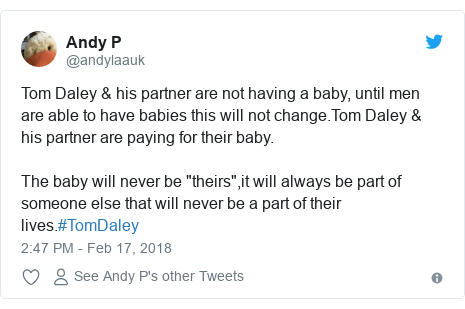
Last month the news reported that a gay couple from Scotland was about to receive an IVF (In-Vitro Fertilization) treatment funded by the NHS, in what is believed to be the first such case in the UK [1]. These news sparked a debate in social media and platforms regarding the right of the gay couples to public funding for what has been called by some a ‘lifestyle choice’ [2]. IVF is available to qualifying same-sex couples on the same basis as heterosexual couples, but in many areas the NHS does not fund fertility treatment involving a surrogate, therefore gay men are effectively excluded. Quoting from the NHS guidelines: “Surrogacy is legal in the UK, but it’s illegal to advertise for surrogates and no financial benefit other than “reasonable expenses” can be paid to the surrogate” [4].

Perhaps the NHS opts out of entering the political, economic and ethical complexities of the commodification of surrogacy, however it could be argued that the result is not an elimination but simply an exportation of the associated ‘externalities’ in other countries such as India – see Singh (2014) and Vora (2013) on inequalities and transnational surrogacy.

Rheinberger (2000) may argue that the natural” and the “social” are no longer to be seen as ontologically different, however the social significance of the divide seems to sustain. I find the below posts linked to a similar debate on gay couples’ surrogacy that occurred last year [3] particularly revealing of how strongly rooted is the notion that the right to reproduction must stem from ‘nature’, despite the wide deployment and acceptance of adoption, IVF and other assisted reproductive technologies from heterosexual couples.

14

As Rose has already noted, persons are drawn by the new practices associated with biotechnology into new kinds of ‘ethopolitics’ that demand new genres of reasoning across micro (here: gay couples choices, constructing of self-identities through debates) and macro scales (here: regulation and NHS funding), a politics of ‘life itself’. Within that politics, the emergence of debates is, and perhaps will remain, continuous.

References

  1. https://www.bionews.org.uk/page_141207 [accessed 10-03-19]
  2. https://www.pinknews.co.uk/2019/01/31/good-morning-britain-gay-surrogacy/ [accessed 10-03-19]
  3. https://www.bbc.co.uk/news/uk-england-devon-43483901 [accessed 10-03-19]
  4. https://www.nhs.uk/live-well/healthy-body/gay-health-having-children/ [accessed 10-03-19]
  5. Rose, Nikolas S., and Rose, Nikolas S. Politics of Life Itself : Biomedicine, Power, and Subjectivity in the Twenty-first Century /Nikolas Rose. Princeton: Princeton UP, 2007. Print. In-formation Ser.
  6. Singh, Holly. “”The World”s Back Womb?”: Commercial Surrogacy and Infertility Inequalities in India.” American Anthropologist4 (2014): 824-828. Web.
  7. Vora, Kalindi. “Potential, Risk, and Return in Transnational Indian Gestational Surrogacy.” Current AnthropologyS7 (2013): S97-106. Web.
  8. Franklin 2001 Biologization Revisited: Kinship Theory in the Context of the New Bi-ologies. In Relative Values: Reconfiguring Kinship Studies. Sarah Franklin and Susan McKinnon, eds. Pp. 302–325. Durham, NC: Duke University Press.
  9. Franklin, Sarah. “Re-thinking Nature—culture: Anthropology and the New Genetics.” Anthropological Theory1 (2003): 65-85. Web.
  10. Rheinberger, H. (2000) “Beyond nature and culture: modes of reasoning in the age of molecular biology and medicine” in M. Lock, A. Young and A. Cambrosio (Eds.) Living and Working with the New Medical Technologies: Intersections of Inquiry. Cambridge: Cambridge University Press. Pp.19-30.
Algorithmic identity: A soft resistance

photo1

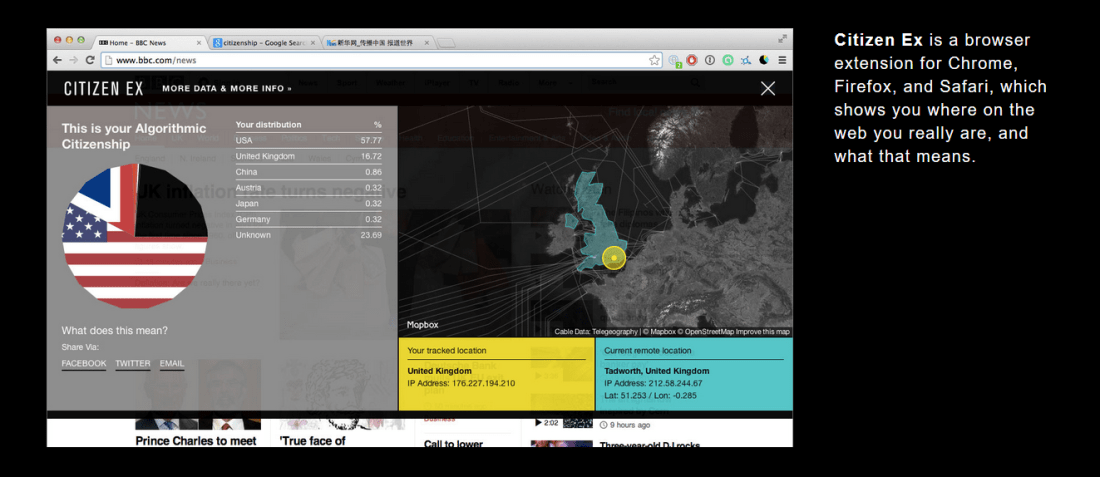
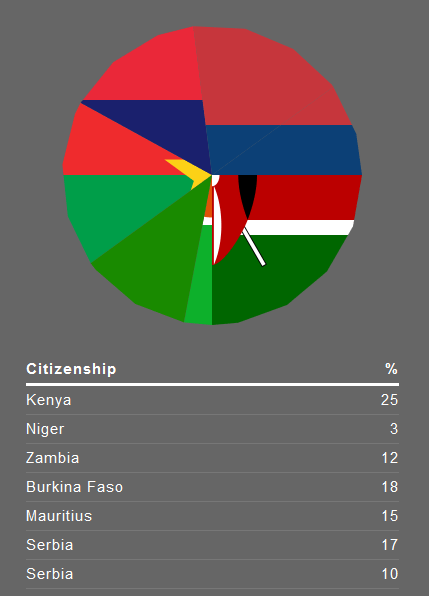
Citizen Ex is a website that helps you to identify your algorithmic citizenship. You simply download an extension for your browser, which tracks the countries where the websites you visit are based and ‘calculates’ what your citizenship is (see below example of result graph).

photo2

James Bridle, the creator of the website, explains in very simple, graspable terms what that means and why it is important. Indeed, the notion of the algorithmic citizenship does not merely constitute a fun statistical graph, but it induces legal consequences. In USA, for example, the National Security Service is allowed to monitor all online data of individuals whose algorithmic citizenship is below 50% from USA – that is because they are not supposed to spy on their own citizens. Therefore, the right to privacy is subject to one’s online data, and is no longer linked to stable, unchangeable properties printed on a passport; rather, whether one is entitled in that right continuously fluctuates based on the websites one visits, the emails one sents etc., as well as the algorithm used to transform these data to identity categories.

photo3

Cheney-Lippold (2011), by whose work this website was inspired, describes this cybernetic form of categorization as soft biopolitics: “ [..] if we describe biopolitics as Foucault does, as ‘the endeavor . . . to rationalize the problems presented to governmental practice by the phenomena characteristic of a group of living human beings constituted as a population’, soft biopolitics constitutes the ways that biopower defines what a population is and determines how that population is discursively situated and developed.” [my emphasis]

One cannot help but wonder where shall we track agency within this structural power context? Chun (2006) argues internet is neither total freedom nor total control. Lupton (2014) in her study of self-tracking modes is not very optimistic and recognizes limited ‘soft resistance’ only in the practices of personal and communal self-tracking. I would argue that cases like Citizen EX website provide a dynamic response to soft biopolitics, markedly utilizing the very same tools to react.


CERN, a social experiment

CERN (Center of European Organization for Nuclear Research) is a European research organization that has attracted a great deal of attention from all disciplines of social sciences as an object of study. Not surprisingly. In CERN operates the largest particle physics laboratory in the world, 10.000 physicists around the world are taking part in the experiments and 2.250 of them are employed at CERN. The Center is established on the Swiss–Franco border and perceived as a hyper-border place for global collaboration, where science exists beyond the politics of nationality. In order to promote cooperation, each article they publish must cite all the participants (sometimes up to 2,500 people) as authors. Moreover, its peer review is quite problematic since the most qualified people in the world to review it are already working in CERN. This unique establishment has been studied in multiple aspects: what are the rituals and symbols of this community? How decisions are made? How the science is articulated through things and sings? What are the processes producing knowledge?

cern photoScientists at CERN, including Fabiola Gianotti, the current Director General
In the following video  Ariana Bottelli presents the results of the interdisciplinary, DFG-funded project-cluster “Epistemology of the LHC – Large Hadron Collider ” (University of Wuppertal, Germany)  that attempted to investigate knowledge production “in real time” by following the interplay of theory and experiment unfold during the first phase of LHC activity and how the knowledge landscape of high energy physics accordingly did (or did not) change.

http://cds.cern.ch/video/1516534?showTitle=true


  1. Zeeya Merali, 2010. Physics: The Large Human Collider, Nature 464, 482-484.
  2. Knorr-Cetina, Karin 1981. The Manufacture of Knowledge: An Essay on the Constructivist and Contextual Nature of Science. Oxford: Pergamon Press.
  3. Roy, Arpita. 2014. Ethnography and Theory of the Signature in Physics. Cultural Anthropology 29, no. 3: 479–502.
  4. Galison, Peter 1997. Image and Logic: A Material Culture of Microphysics. Chicago: University of Chicago Press.
  5. Pickering, Andrew 1984. Constructing Quarks: A Sociological History of Particle Physics. Chicago: University of Chicago Press.
  6. Merz, M. & Knorr Cetina, K., 1997. Deconstruction in a `Thinking’ Science: Theoretical Physicists at Work, Social Studies of Science 27 (1): 73-111.


Albinos: One artwork and three myths.

I recently visited the Athens Biennale 2018 and one of the artworks that caught my attention was Lykourgos Porfyris’s Kakurlackó Order: Department of Culture and Heritage.

porfyris
[Part of the Kakurlackó Order: Department of Culture and Heritage]

The artist “…focuses on the representation of albinos and albinism in occidental history and contemporary pop culture. [..]Drawing upon his personal research and experience as an albino, Porfyris comes to terms with processes of demonization / fetishization by iterating, synthetizing, and narrativizing the unknown story of albinism”. [1]

Indeed albinism has been greatly demonized across cultures, although not all. What is an albino? The answer depends heavily on the sociocultural contexts:

Tanzania witchcraft believer: It is a zeruzeru (ghost), mzungu (white person) or dili.

—-This latter term means ‘deal’, and refers to the trade of the body parts of people with albinism on the black market. It is related to the phenomenon that began in the mid to late 2000s whereby ‘traditional doctors’ (waganga wa kenyeji) began to target individuals with albinism in Tanzania’s north-west regions, whom they would kill in order to use their bones and blood to make amulets, which it was claimed brought their wearers luck and wealth [3].

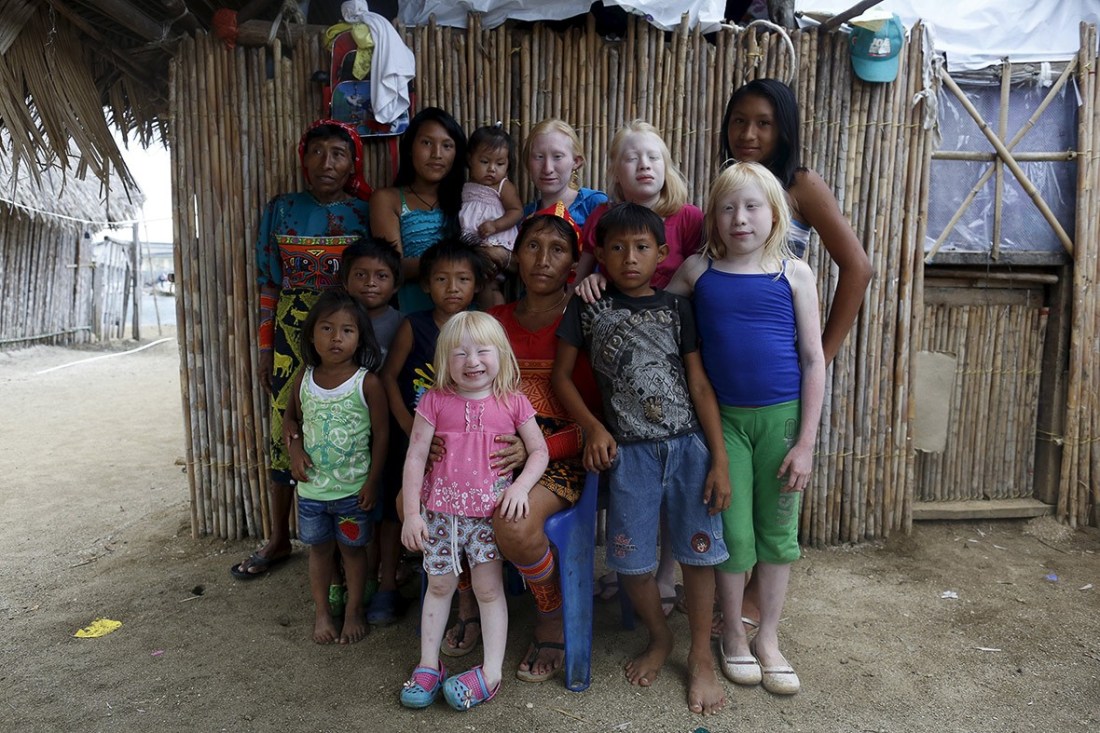
Guna (tribe in Panama and Central America) mother: They are the Children of the Moon, very special to us. They have the specific duty of defending the Moon against a dragon which tries to eat it on occasion during a Lunar eclipse, and only they are allowed to go outside on the night of a Lunar eclipse and to use specially made bows and arrows to shoot down the dragon [7].
—-The Guna people have the one of the highest incident rates of albinism in the world [7].

guna

Four albino sisters – Iveily, Donilcia, Jade and Yaisseth Morales – pose for a photograph with their mother, brothers and sisters outside their house on Ustupu Island in the Guna Yala region of Panama [Carlos Jasso/Reuters]

European doctor: Albinism is an inherited disorder of melanin biosynthesis that results in a variable phenotype classified according to the mutation in one of several genes.  [5].

In the western modern context, the first two would be categorized as beliefs and the last one as knowledge. To what extent that enlightens or conceals our understanding of the world and albinos’ place in it? What each of these approaches tells us and what does it fail to say? Moreover, at the same time that we draw the line knowledge/gibberish, we make moral judgements: the Tanzanian belief is atrocious and appalling; the Guna belief is soul touching and beautiful. However, the third one escapes our moral judgement because we regard it as ‘pure fact’. But should it?

1. https://anti.athensbiennale.org/en/artist/lykourgos-porfyris
2. https://www.nhs.uk/conditions/albinism/
3. Brocco G. (2016). Albinism, stigma, subjectivity and global-local discourses in Tanzania. Anthropology & medicine, 23(3), 229-243.
4. Jeambrun P. (1998). L’albinisme oculocutané: mises au point clinique, historique et anthropologique [Oculocutaneous albinism: clinical, historical and anthropological aspects]. Archives de Pédiatrie (in French). Société française de pédiatrie. 5 (8): 896–907.
5. Brilliant MH. (2015). Albinism in Africa: a medical and social emergency. Int Health. 7(4):223-5.