Last month the news reported that a gay couple from Scotland was about to receive an IVF (In-Vitro Fertilization) treatment funded by the NHS, in what is believed to be the first such case in the UK [1]. These news sparked a debate in social media and platforms regarding the right of the gay couples to public funding for what has been called by some a ‘lifestyle choice’ [2]. IVF is available to qualifying same-sex couples on the same basis as heterosexual couples, but in many areas the NHS does not fund fertility treatment involving a surrogate, therefore gay men are effectively excluded. Quoting from the NHS guidelines: “Surrogacy is legal in the UK, but it’s illegal to advertise for surrogates and no financial benefit other than “reasonable expenses” can be paid to the surrogate” [4].
Perhaps the NHS opts out of entering the political, economic and ethical complexities of the commodification of surrogacy, however it could be argued that the result is not an elimination but simply an exportation of the associated ‘externalities’ in other countries such as India – see Singh (2014) and Vora (2013) on inequalities and transnational surrogacy.
Rheinberger (2000) may argue that the natural” and the “social” are no longer to be seen as ontologically different, however the social significance of the divide seems to sustain. I find the below posts linked to a similar debate on gay couples’ surrogacy that occurred last year [3] particularly revealing of how strongly rooted is the notion that the right to reproduction must stem from ‘nature’, despite the wide deployment and acceptance of adoption, IVF and other assisted reproductive technologies from heterosexual couples.
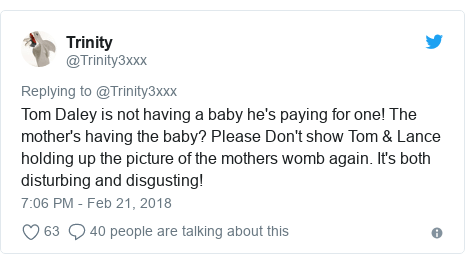
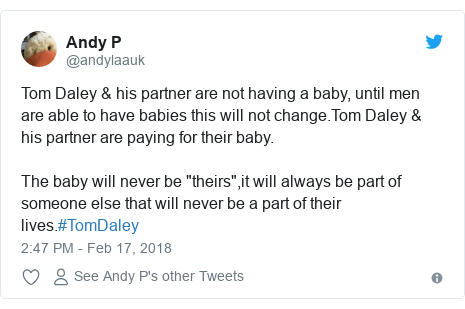
As Rose has already noted, persons are drawn by the new practices associated with biotechnology into new kinds of ‘ethopolitics’ that demand new genres of reasoning across micro (here: gay couples choices, constructing of self-identities through debates) and macro scales (here: regulation and NHS funding), a politics of ‘life itself’. Within that politics, the emergence of debates is, and perhaps will remain, continuous.
References
- https://www.bionews.org.uk/page_141207 [accessed 10-03-19]
- https://www.pinknews.co.uk/2019/01/31/good-morning-britain-gay-surrogacy/ [accessed 10-03-19]
- https://www.bbc.co.uk/news/uk-england-devon-43483901 [accessed 10-03-19]
- https://www.nhs.uk/live-well/healthy-body/gay-health-having-children/ [accessed 10-03-19]
- Rose, Nikolas S., and Rose, Nikolas S. Politics of Life Itself : Biomedicine, Power, and Subjectivity in the Twenty-first Century /Nikolas Rose. Princeton: Princeton UP, 2007. Print. In-formation Ser.
- Singh, Holly. “”The World”s Back Womb?”: Commercial Surrogacy and Infertility Inequalities in India.” American Anthropologist4 (2014): 824-828. Web.
- Vora, Kalindi. “Potential, Risk, and Return in Transnational Indian Gestational Surrogacy.” Current AnthropologyS7 (2013): S97-106. Web.
- Franklin 2001 Biologization Revisited: Kinship Theory in the Context of the New Bi-ologies. In Relative Values: Reconfiguring Kinship Studies. Sarah Franklin and Susan McKinnon, eds. Pp. 302–325. Durham, NC: Duke University Press.
- Franklin, Sarah. “Re-thinking Nature—culture: Anthropology and the New Genetics.” Anthropological Theory1 (2003): 65-85. Web.
- Rheinberger, H. (2000) “Beyond nature and culture: modes of reasoning in the age of molecular biology and medicine” in M. Lock, A. Young and A. Cambrosio (Eds.) Living and Working with the New Medical Technologies: Intersections of Inquiry. Cambridge: Cambridge University Press. Pp.19-30.

 Scientists at CERN, including Fabiola Gianotti, the current Director General
 ssb-anthropology