
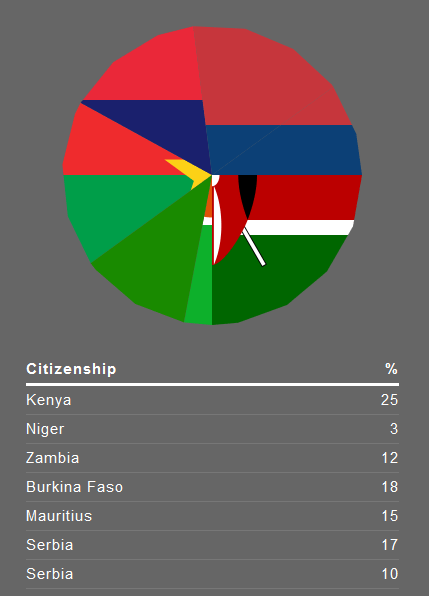
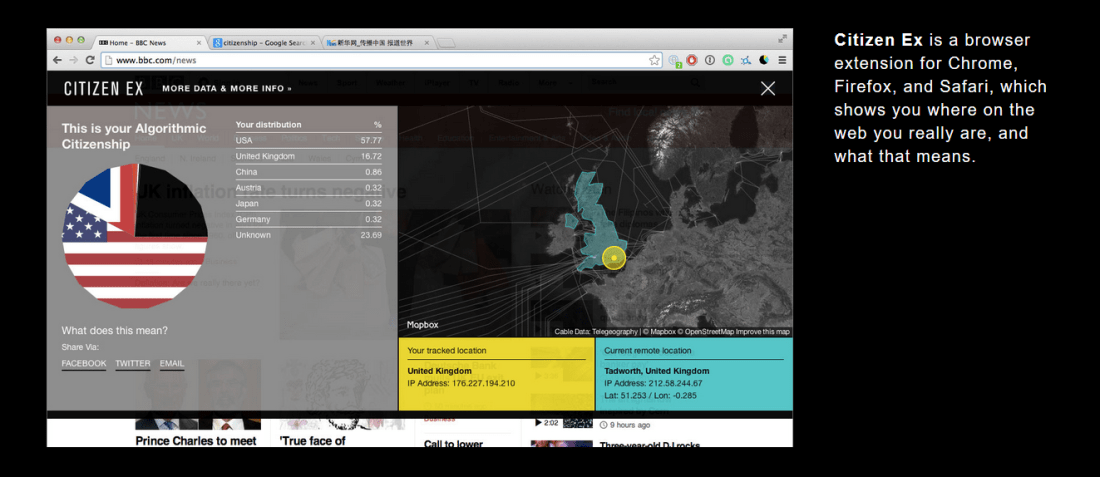
Citizen Ex is a website that helps you to identify your algorithmic citizenship. You simply download an extension for your browser, which tracks the countries where the websites you visit are based and ‘calculates’ what your citizenship is (see below example of result graph).
James Bridle, the creator of the website, explains in very simple, graspable terms what that means and why it is important. Indeed, the notion of the algorithmic citizenship does not merely constitute a fun statistical graph, but it induces legal consequences. In USA, for example, the National Security Service is allowed to monitor all online data of individuals whose algorithmic citizenship is below 50% from USA – that is because they are not supposed to spy on their own citizens. Therefore, the right to privacy is subject to one’s online data, and is no longer linked to stable, unchangeable properties printed on a passport; rather, whether one is entitled in that right continuously fluctuates based on the websites one visits, the emails one sents etc., as well as the algorithm used to transform these data to identity categories.
Cheney-Lippold (2011), by whose work this website was inspired, describes this cybernetic form of categorization as soft biopolitics: “ [..] if we describe biopolitics as Foucault does, as ‘the endeavor . . . to rationalize the problems presented to governmental practice by the phenomena characteristic of a group of living human beings constituted as a population’, soft biopolitics constitutes the ways that biopower defines what a population is and determines how that population is discursively situated and developed.” [my emphasis]
One cannot help but wonder where shall we track agency within this structural power context? Chun (2006) argues internet is neither total freedom nor total control. Lupton (2014) in her study of self-tracking modes is not very optimistic and recognizes limited ‘soft resistance’ only in the practices of personal and communal self-tracking. I would argue that cases like Citizen EX website provide a dynamic response to soft biopolitics, markedly utilizing the very same tools to react.
- Cheney-Lippold.J (2011) A new algorithmic Identity. Theory, Culture and Society 28 (6): 161-181
- Chun,W.H.K. (2006) Control and Freedom: Power and Paranoia in the Age of Fiber Optics. Cambridge, MA: MIT Press.
- Lupton, D. (2014) Self tracking modes; Reflexive self monitoring and data practices. Conference paper available https://www.academia.edu/8043441/Self-tracking_Modes_Reflexive_Self-Monitoring_and_Data_Practices

 ssb-anthropology