I recently visited the Athens Biennale 2018 and one of the artworks that caught my attention was Lykourgos Porfyris’s Kakurlackó Order: Department of Culture and Heritage.

[Part of the Kakurlackó Order: Department of Culture and Heritage]
The artist “…focuses on the representation of albinos and albinism in occidental history and contemporary pop culture. [..]Drawing upon his personal research and experience as an albino, Porfyris comes to terms with processes of demonization / fetishization by iterating, synthetizing, and narrativizing the unknown story of albinism”. [1]
Indeed albinism has been greatly demonized across cultures, although not all. What is an albino? The answer depends heavily on the sociocultural contexts:
Tanzania witchcraft believer: It is a zeruzeru (ghost), mzungu (white person) or dili.
—-This latter term means ‘deal’, and refers to the trade of the body parts of people with albinism on the black market. It is related to the phenomenon that began in the mid to late 2000s whereby ‘traditional doctors’ (waganga wa kenyeji) began to target individuals with albinism in Tanzania’s north-west regions, whom they would kill in order to use their bones and blood to make amulets, which it was claimed brought their wearers luck and wealth [3].
Guna (tribe in Panama and Central America) mother: They are the Children of the Moon, very special to us. They have the specific duty of defending the Moon against a dragon which tries to eat it on occasion during a Lunar eclipse, and only they are allowed to go outside on the night of a Lunar eclipse and to use specially made bows and arrows to shoot down the dragon [7].
—-The Guna people have the one of the highest incident rates of albinism in the world [7].
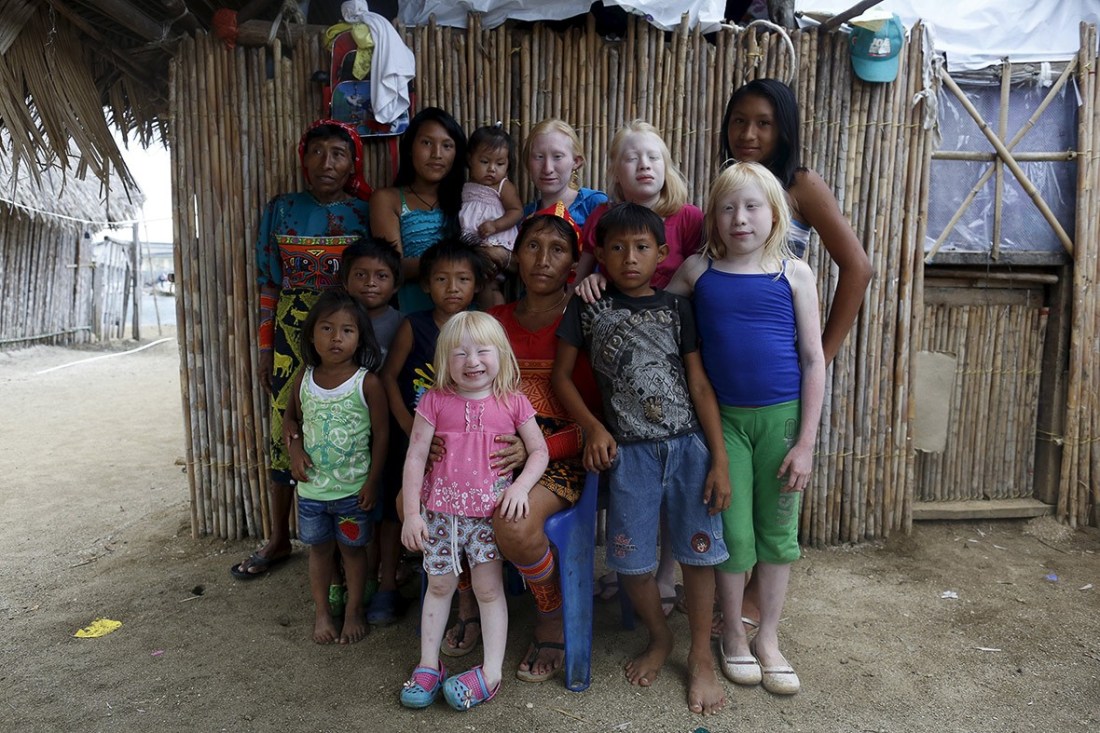
Four albino sisters – Iveily, Donilcia, Jade and Yaisseth Morales – pose for a photograph with their mother, brothers and sisters outside their house on Ustupu Island in the Guna Yala region of Panama [Carlos Jasso/Reuters]
European doctor: Albinism is an inherited disorder of melanin biosynthesis that results in a variable phenotype classified according to the mutation in one of several genes. [5].
In the western modern context, the first two would be categorized as beliefs and the last one as knowledge. To what extent that enlightens or conceals our understanding of the world and albinos’ place in it? What each of these approaches tells us and what does it fail to say? Moreover, at the same time that we draw the line knowledge/gibberish, we make moral judgements: the Tanzanian belief is atrocious and appalling; the Guna belief is soul touching and beautiful. However, the third one escapes our moral judgement because we regard it as ‘pure fact’. But should it?
1. https://anti.athensbiennale.org/en/artist/lykourgos-porfyris
2. https://www.nhs.uk/conditions/albinism/
3. Brocco G. (2016). Albinism, stigma, subjectivity and global-local discourses in Tanzania. Anthropology & medicine, 23(3), 229-243.
4. Jeambrun P. (1998). L’albinisme oculocutané: mises au point clinique, historique et anthropologique [Oculocutaneous albinism: clinical, historical and anthropological aspects]. Archives de Pédiatrie (in French). Société française de pédiatrie. 5 (8): 896–907.
5. Brilliant MH. (2015). Albinism in Africa: a medical and social emergency. Int Health. 7(4):223-5.

 ssb-anthropology